Virtual Tool-use: Do tool-use effects extend to Virtual Reality?

Joshua D. Bell

Oregon State University

OptiTrack

Kristen L. Macuga

Oregon State University

Outline

  1. Introduction
    1. Human Tool-Use
    2. Tool Embodiment
    3. Evidence
    4. Criticisms
    5. Motivations
  2. Study One: Do Tool-Use Effects Extend to VR?
  3. Studies Two & Three: Just a Tool, After All?
  4. General Conclusion

Introduction

Human Tool-Use

  • Tool-use is a defining feature of the human species
  • Experts experience tools as natural extensions
  • Cognitive basis of tool-use is still unclear1
  • Understanding is important to tool and prosthetic design
  • One leading perspective: Tool Embodiment

What is Tool Embodiment?

  • Body Representation: Internal estimate of posture, size, weight, and shape1
    • The body representation is a mental model
  • Tool Embodiment: Tools are incorporated into the body representation2
    • i.e., Tool-use shapes the body
    • Tools are perceived as if part of the body3

Evidence: Iriki et al., (1996)

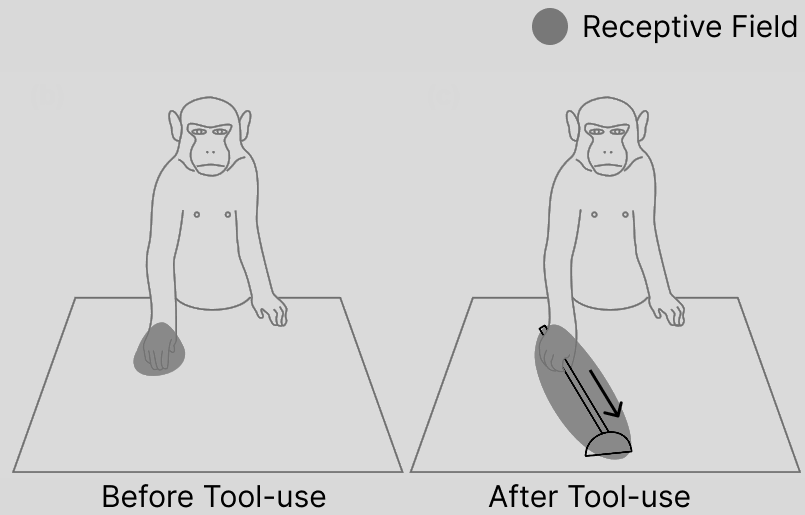
  • Two Macaque monkeys trained to use a tool to obtain food
  • Neurons that selectively respond to stimuli near the hand extended to the tool
  • Conclusion: The tool “becomes an extension of the hand in both a physical and perceptual sense” (p. 2325)
    • i.e., the tool becomes part of the body.

Maravita and Iriki (2004)

Evidence: Cardinali et al., (2009)

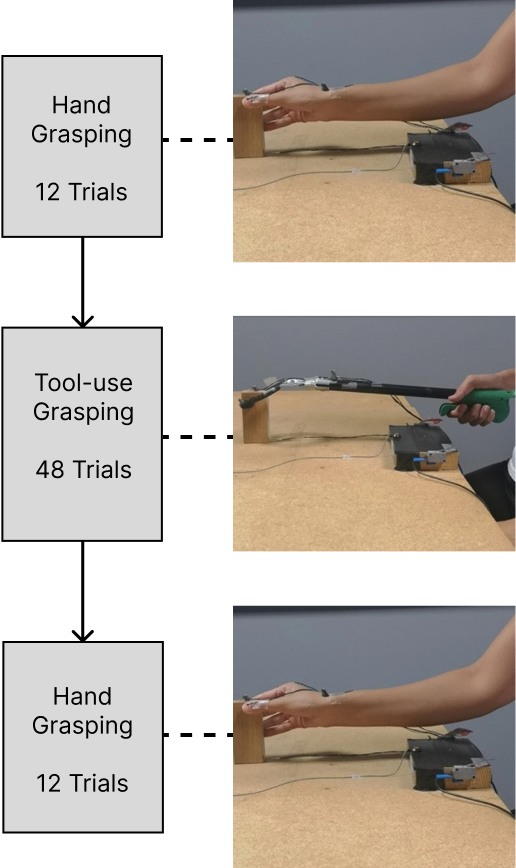
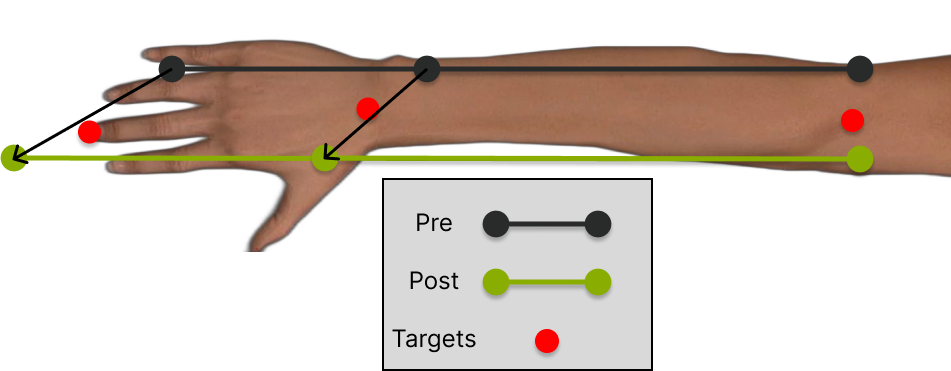
  • Participants reached to grasp an object with the hand pre-and post-tool-use
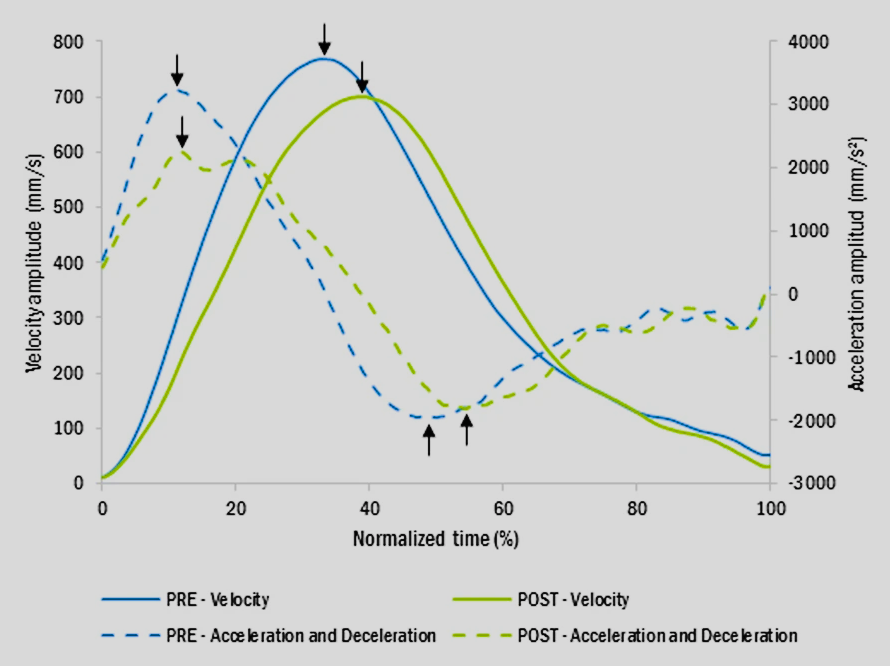
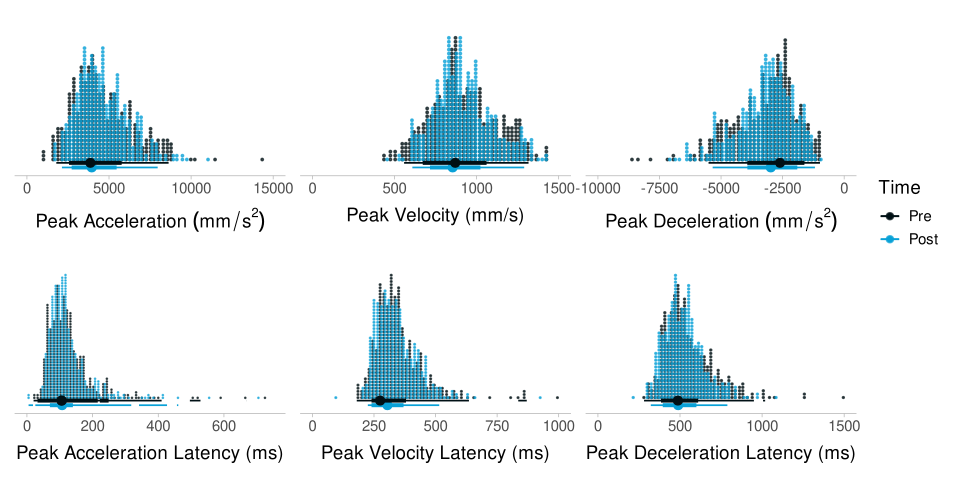
  • Kinematic data (velocity, acceleration) was collected
  • Post tool-use movements (green lines) resembled movements of longer-armed participants
  • Post tool-use arm landmark judgments implied a longer “arm”
  • Conclusion: Tool-use lengthened the arm representation

Adapted from Bahmad et al. (2020)
Martel et al. (2019) Figure 3
Adapted from Cardinali et al. (2009) Figure 1

Criticisms: Bell & Macuga (2022)

Criticisms: Bell & Macuga (2022)

  1. Evidence does not favor changes in movement as “arm extension”
    • Primary evidence: Relationship between arm length and kinematics1
      • Based on a nonsignificant t-test and confounded correlations
      • Prior work is heavily unsupportive2
    • Secondary evidence: Landmark localizations change after tool-use
      • Never observed within the same set of participants
  2. Insufficient controls and low generalizability3

Motivations

  • Investigate criticisms through extension of Cardinali et al., (2009)
  • Initial plan:
    1. Reproduce tool-use effects (kinematic, landmark changes) in virtual reality

    2. Manipulate tool-use task

    3. Collect data on relationship between movement, forearm length, and landmark localization

Study One: Do Tool-Use Effects Extend to VR?

  • Extension of Cardinali et al. (2009) tool-use paradigm to VR
  • Added landmark localization task

Pre-registered hypotheses:

  • H1: Shorter kinematic peaks and longer latencies post tool-use.
  • H2: Distal landmark localization biases post tool-use.
If H1 and H2 are supported, then:
  • H3: Kinematic and landmark localization effects should be correlated.

Justification

Why Virtual Reality?

  • Highly-controllable environments, variables, and stimuli
  • Little work combining VR and tool-use1
  • Potential to set a precedent of transparency via open-sourcing2

Why reproduce the effects?

  • Concerns about influence of VR on vision for action3
  • Our previous work showed no tool-use effects in a novel task4
  • Paradigm has failed to replicate5
  • Replication is a cornerstone of science

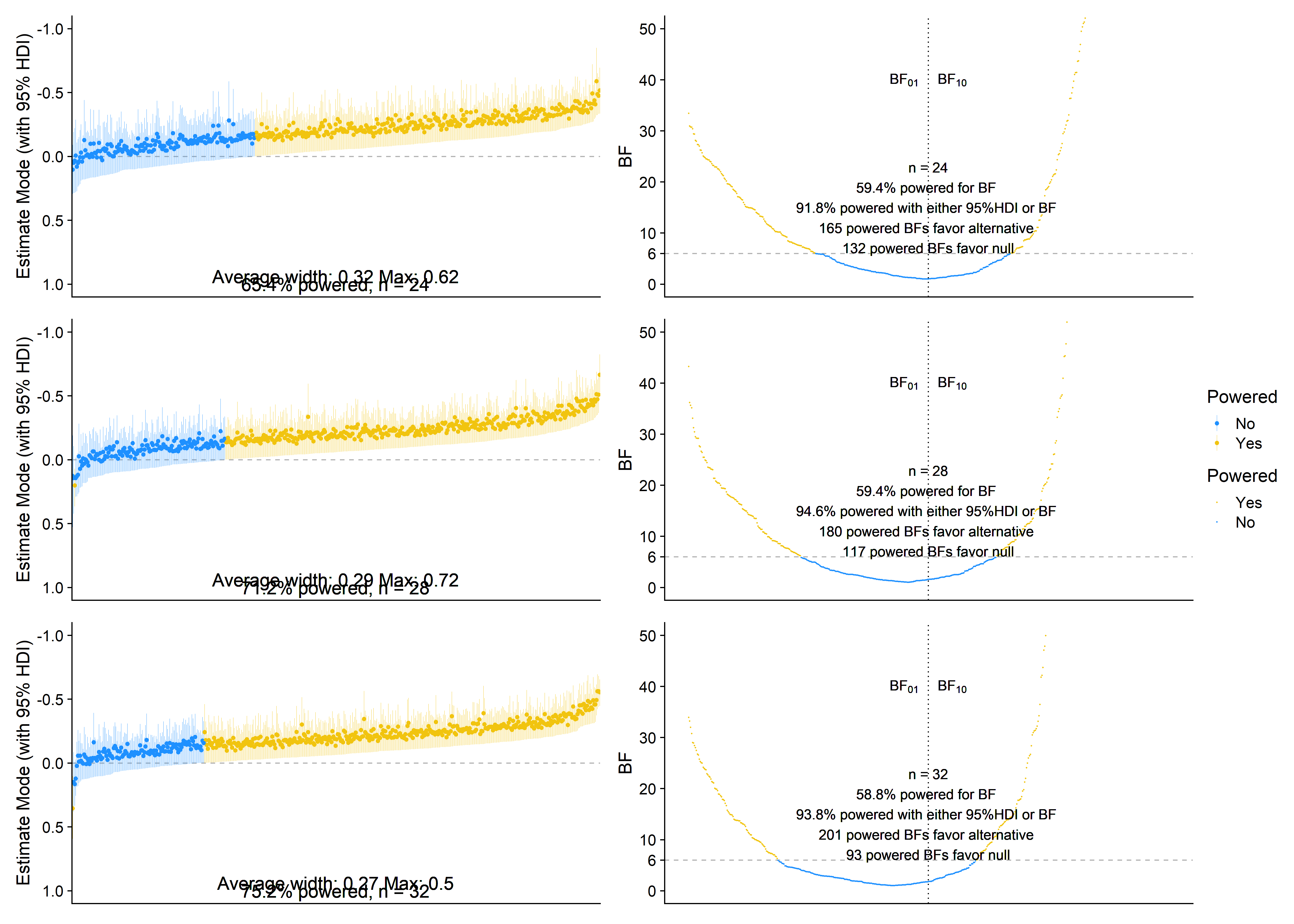
Power Analysis & Sample

  • Bayesian Power Analysis1

  • Sequential Bayes Factor Design2

  • n = 24 participants

    • \(M_{age} = 28.42\) years, \(SD_{age} = 13.11\)
    • 12 female, 11 male, 1 non-binary

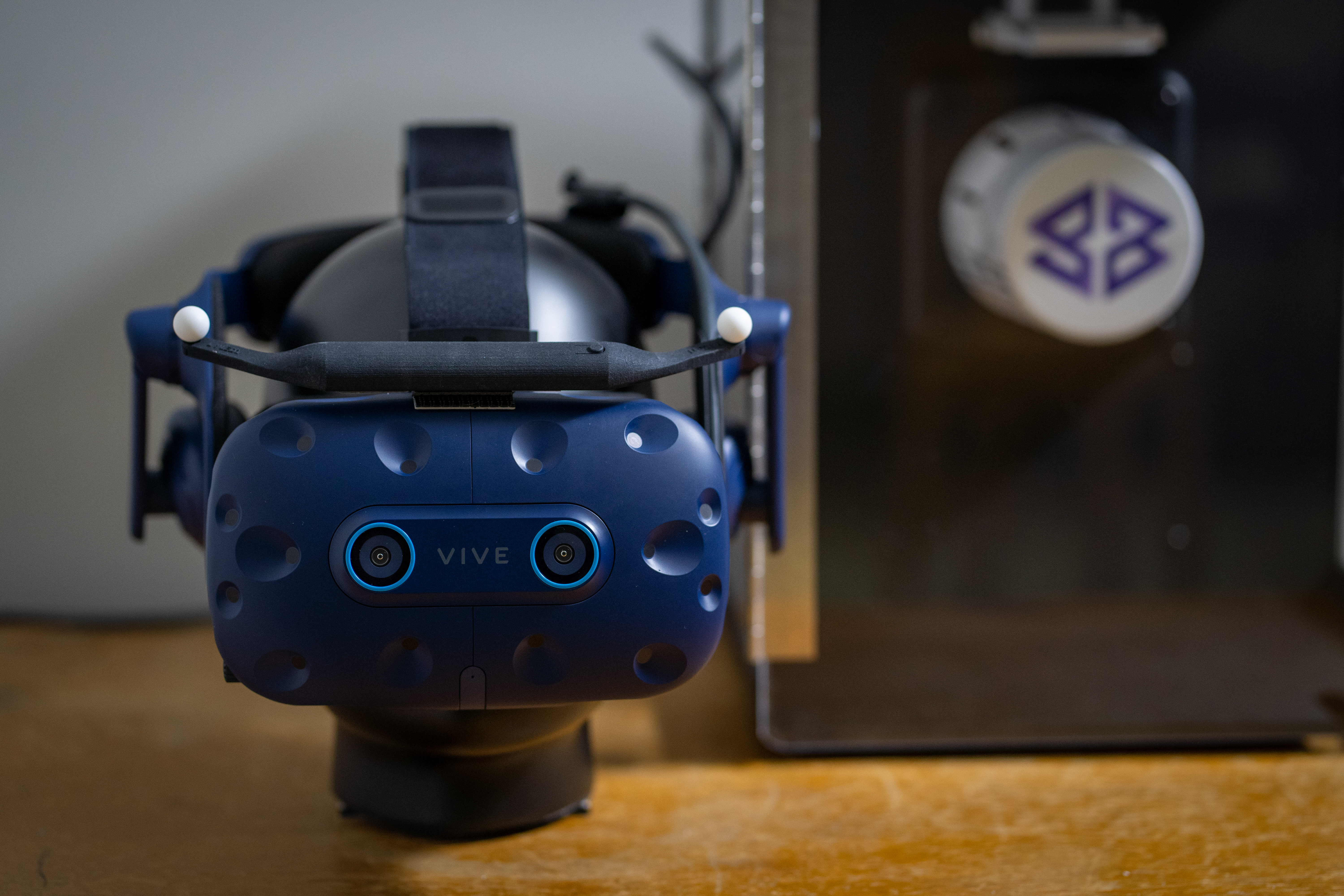
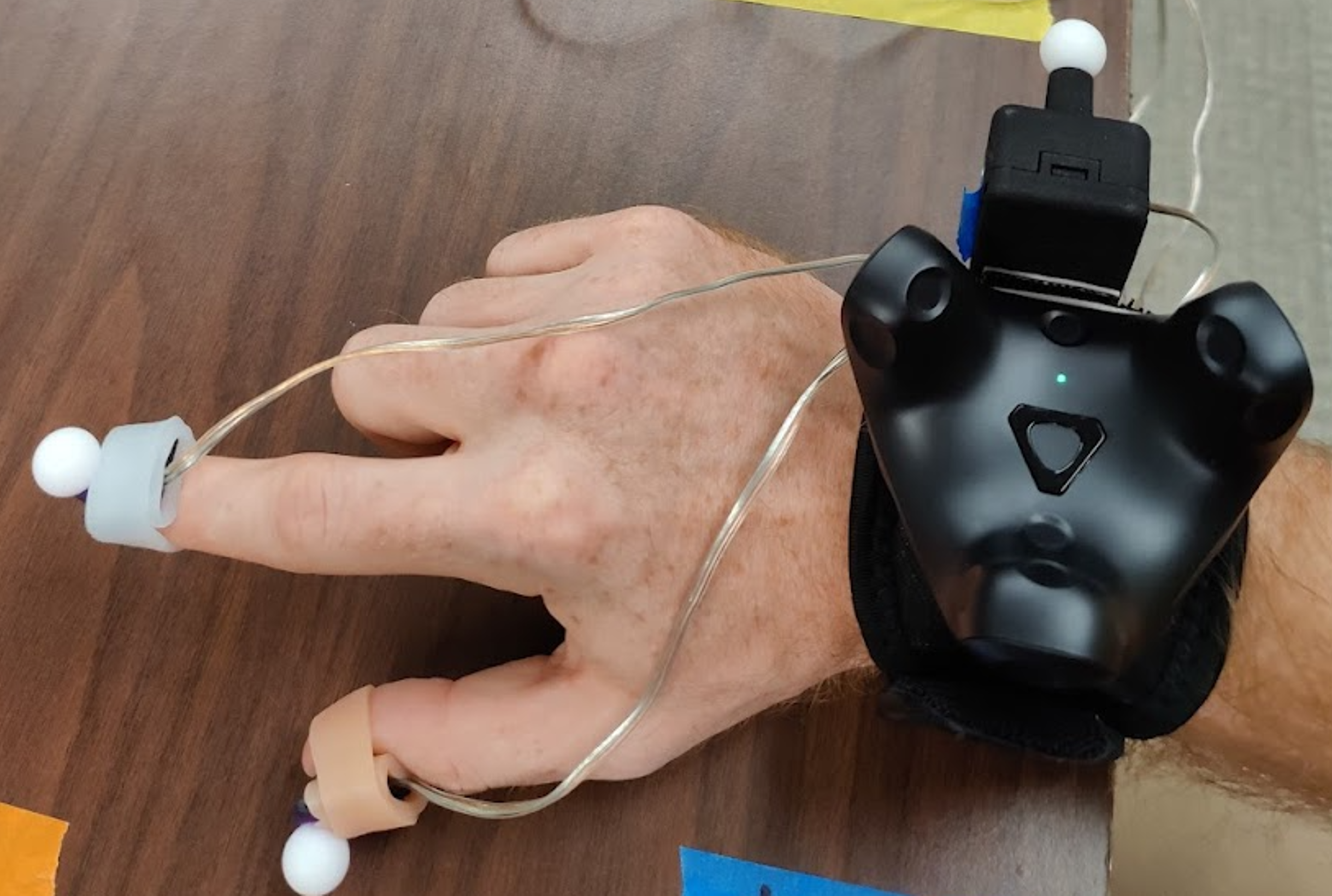
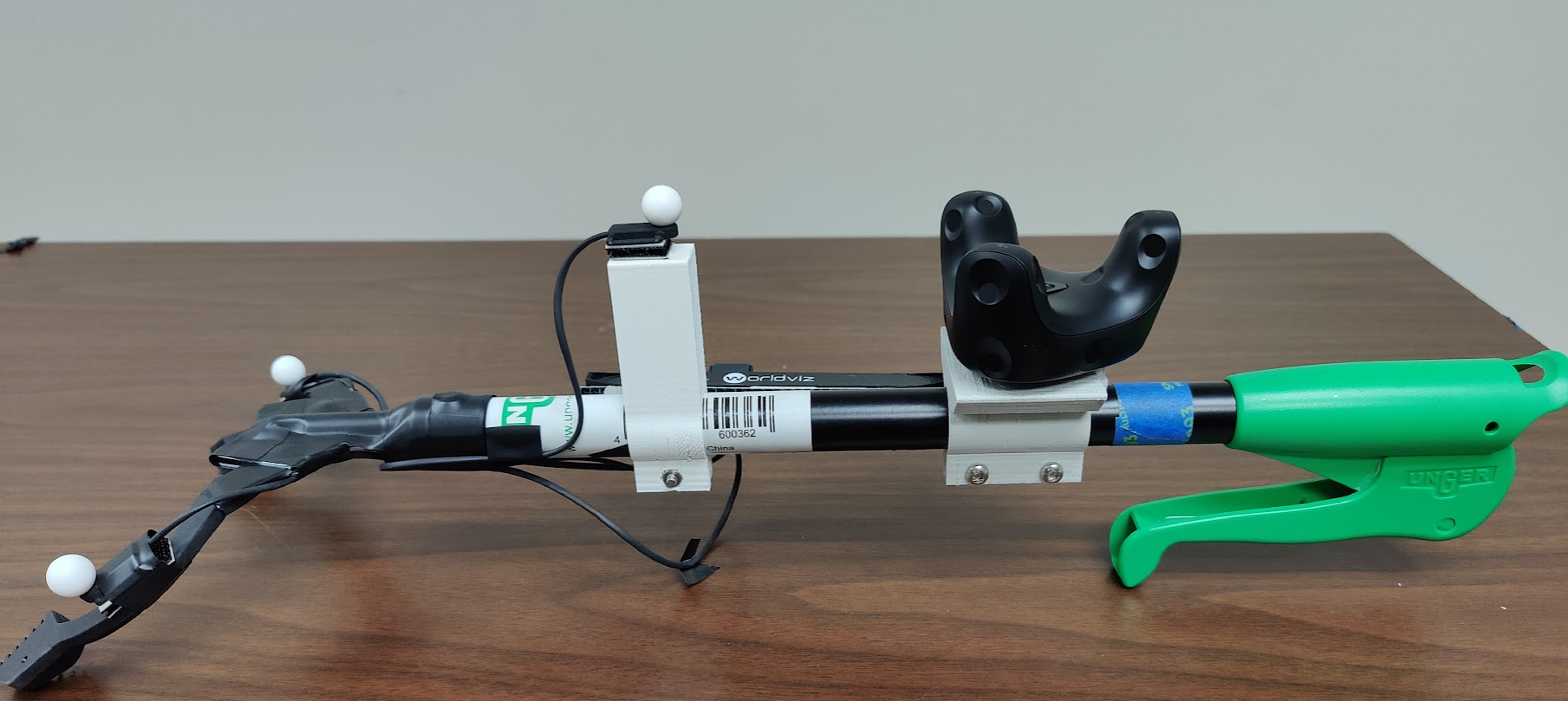
Apparatus

Apparatus

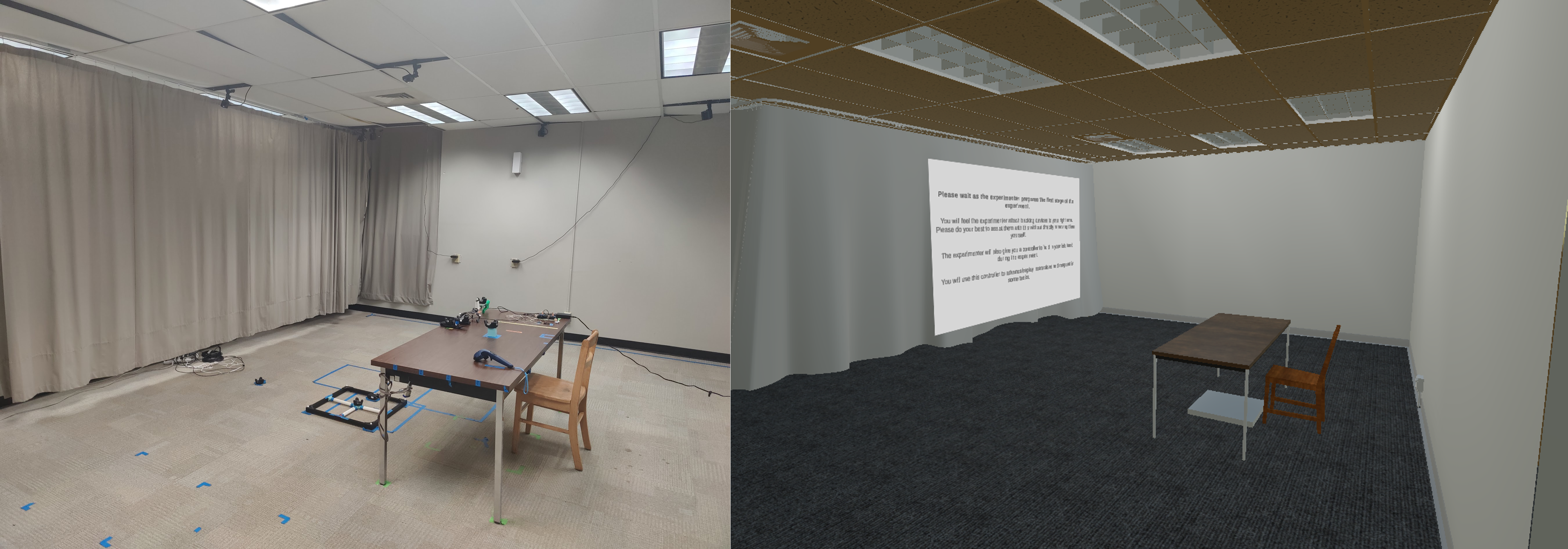
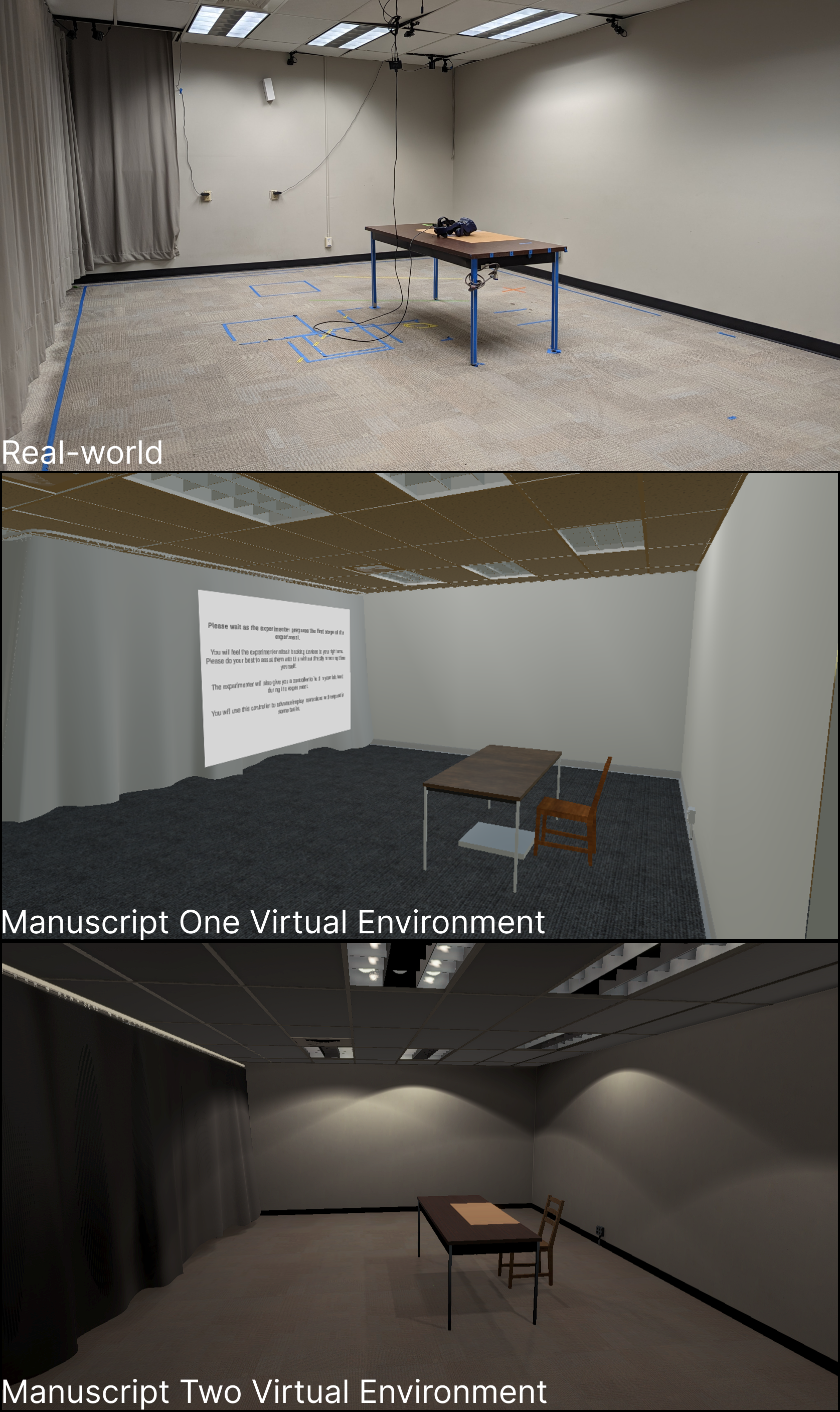
Lab Environment

  • Lab space recreation in VR

Apparatus

Virtual Representations

  • Hand and tool representations

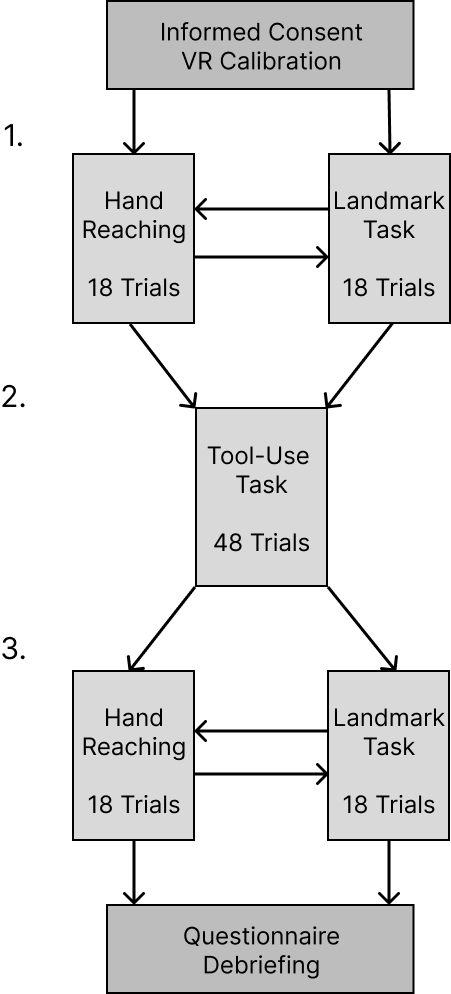
Procedure

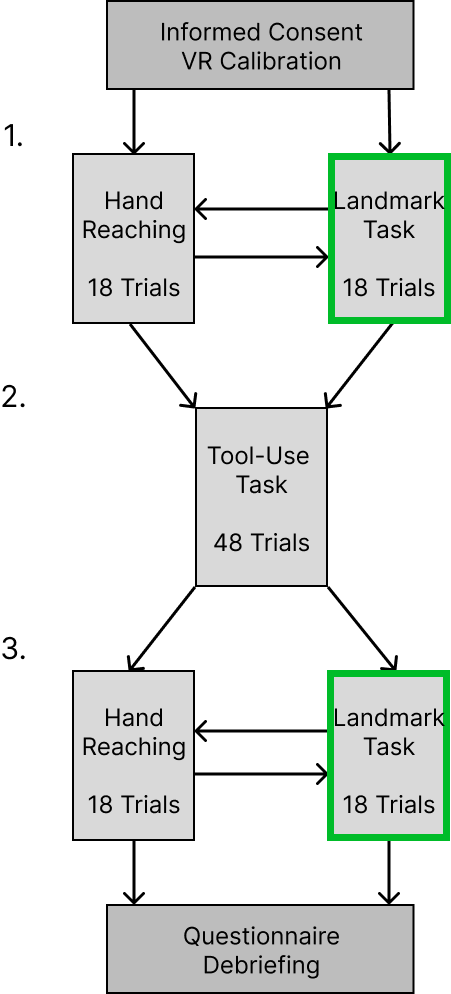
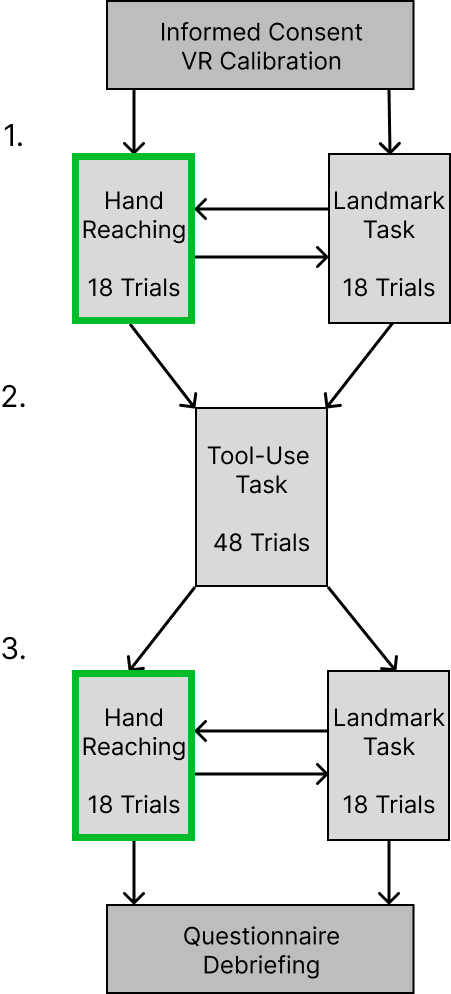
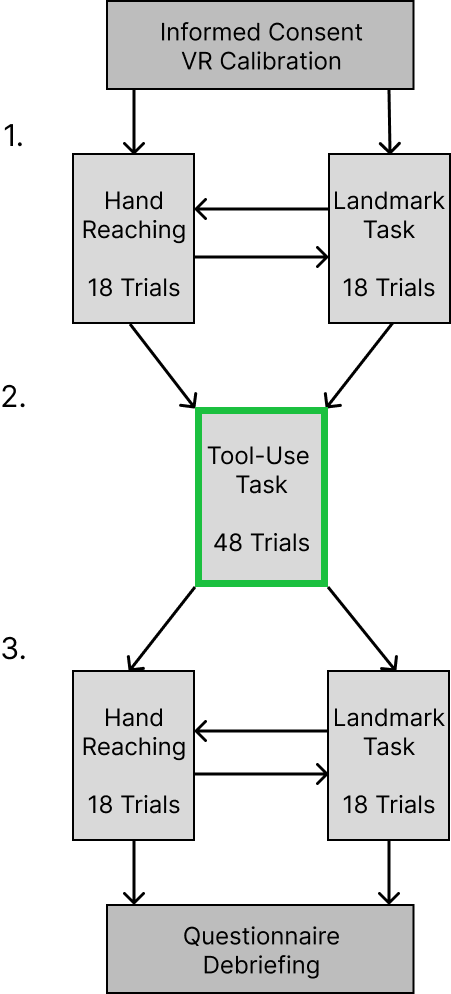
  1. Calibration
    1. Eye-tracker
    2. Walking (60s)
  2. Tasks
    1. Landmark Localization
    2. Reaching
    3. Tool-use
  3. Post-experiment Questionnaire
    1. Demographics
    2. Hypothesis
    3. Experience

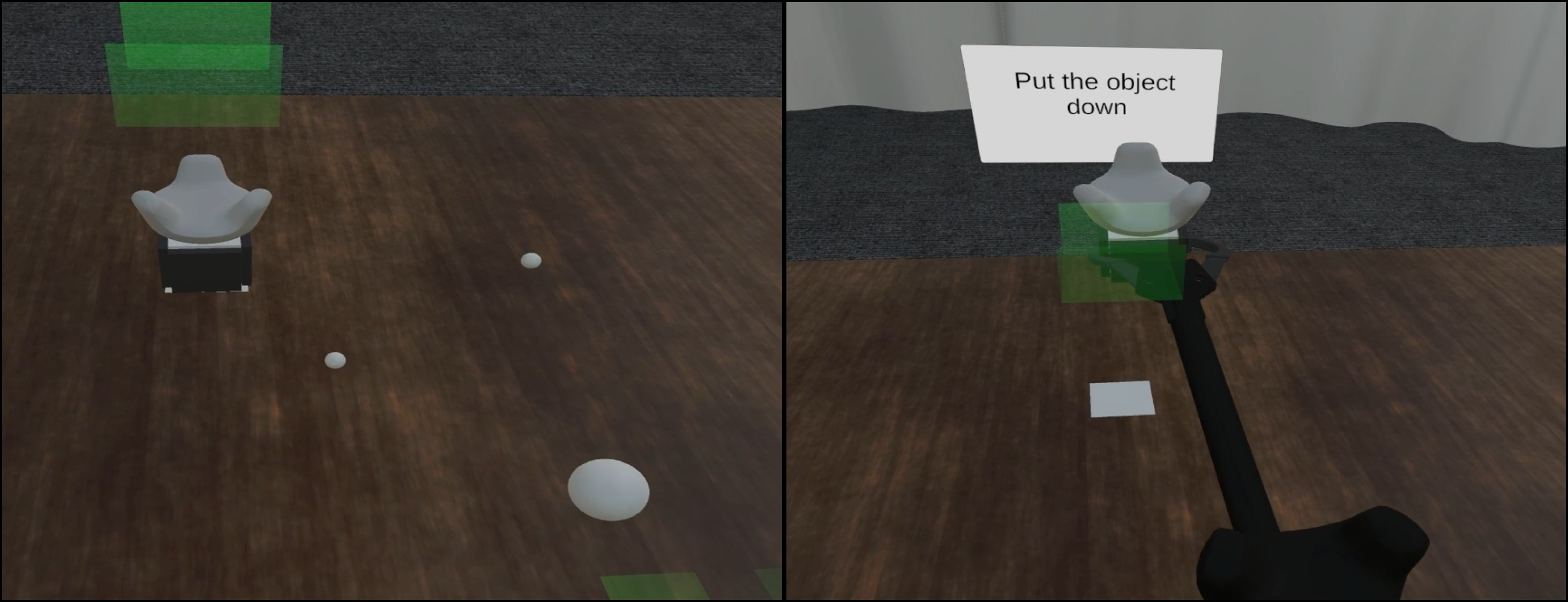
Tasks: Landmark Localization

Tasks: Landmark Localization

Tasks: Landmark Localization

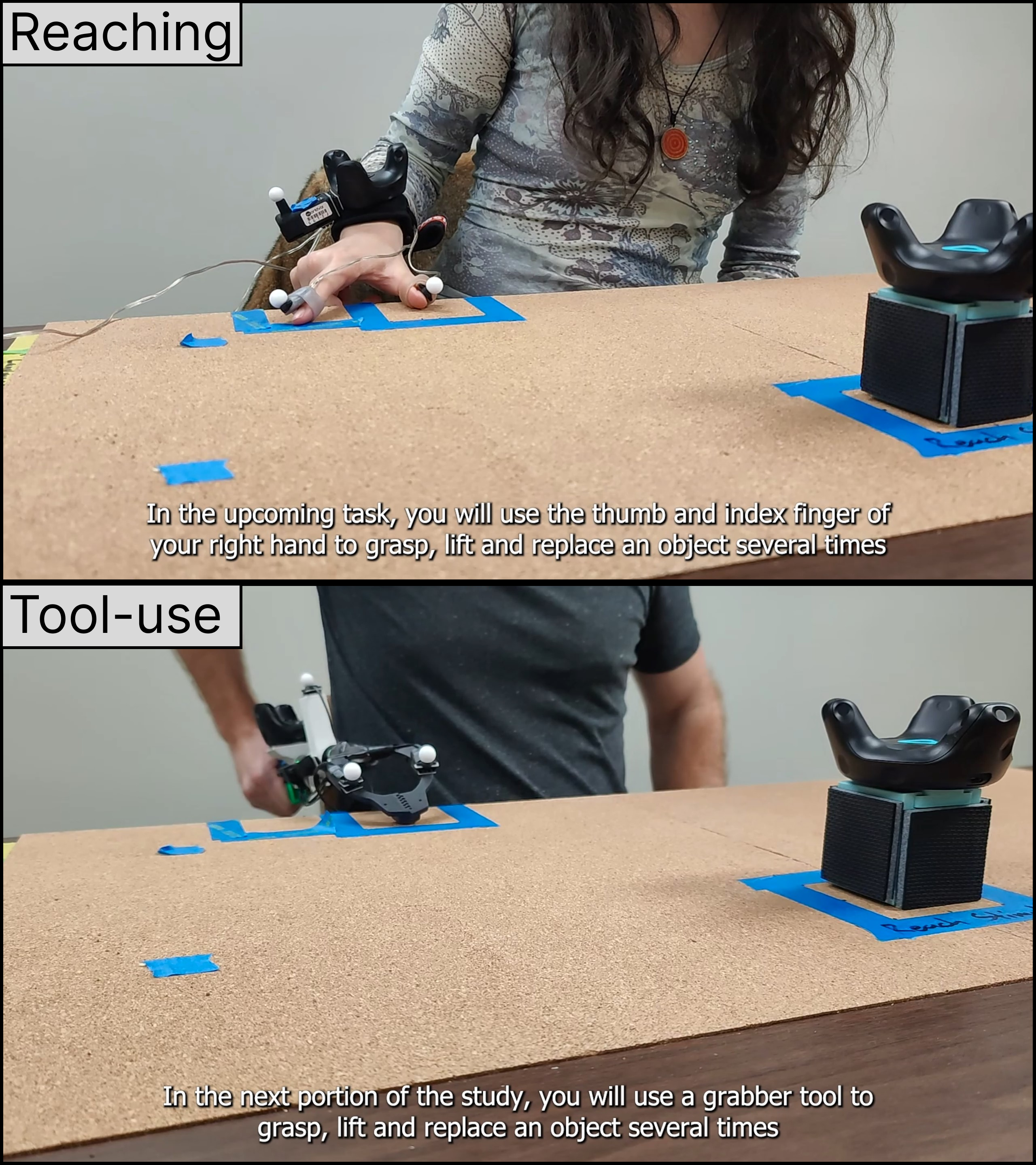
Tasks: Reaching

Tasks: Tool-use

Analysis: Kinematics

Kinematic Analysis

Analysis Plan

  • Hierarchical Bayesian models1
    • Reaching: Kinematic Outcomes by Time (Pre, Post)
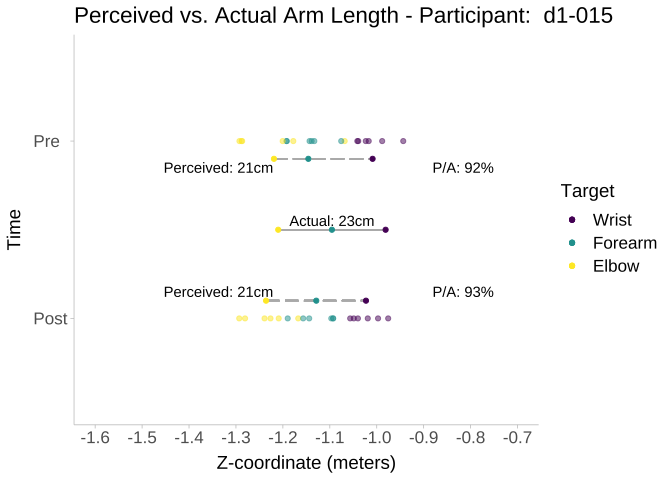
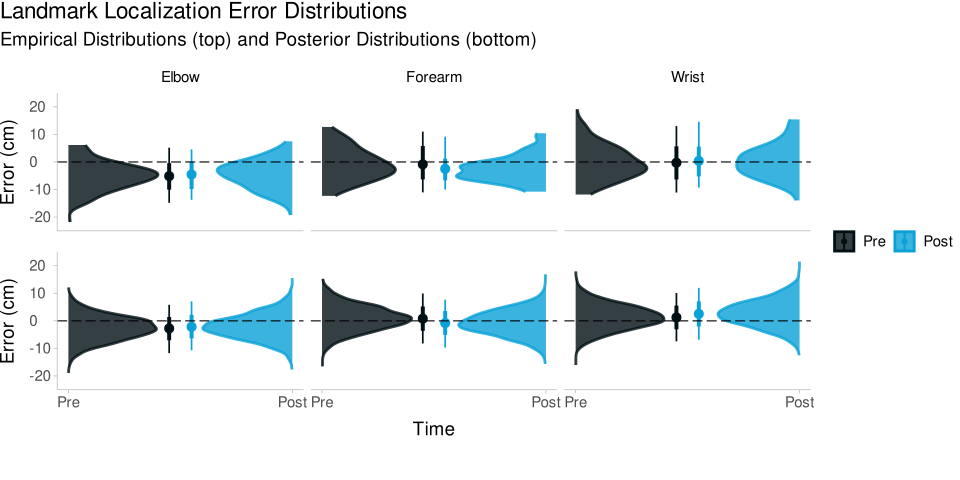
    • Landmark Task: Error by Time (Pre, Post) and Target (Wrist, Forearm, Elbow)
  • Analyses preregistered on OSF2
  • Hypothesis Tests: One-sided Bayes Factors (\(BFs\))3
    • Ratio of likelihoods of two hypotheses given the data
    • \(BF > 1\) indicates evidence for \(H_1\) (the expected effect of tool-use)
    • \(BF < 1\) indicates evidence for \(H_0\) (the complement of the expected effect)
    • \(\frac{1}{6} > BF > 6\) was the preregistered evidence threshold
  • The data and analysis code are available on Github: https://github.com/JashoBell/vr-tool-use-results

Results: Reaching Task

Empirical Distributions of Kinematic Parameters

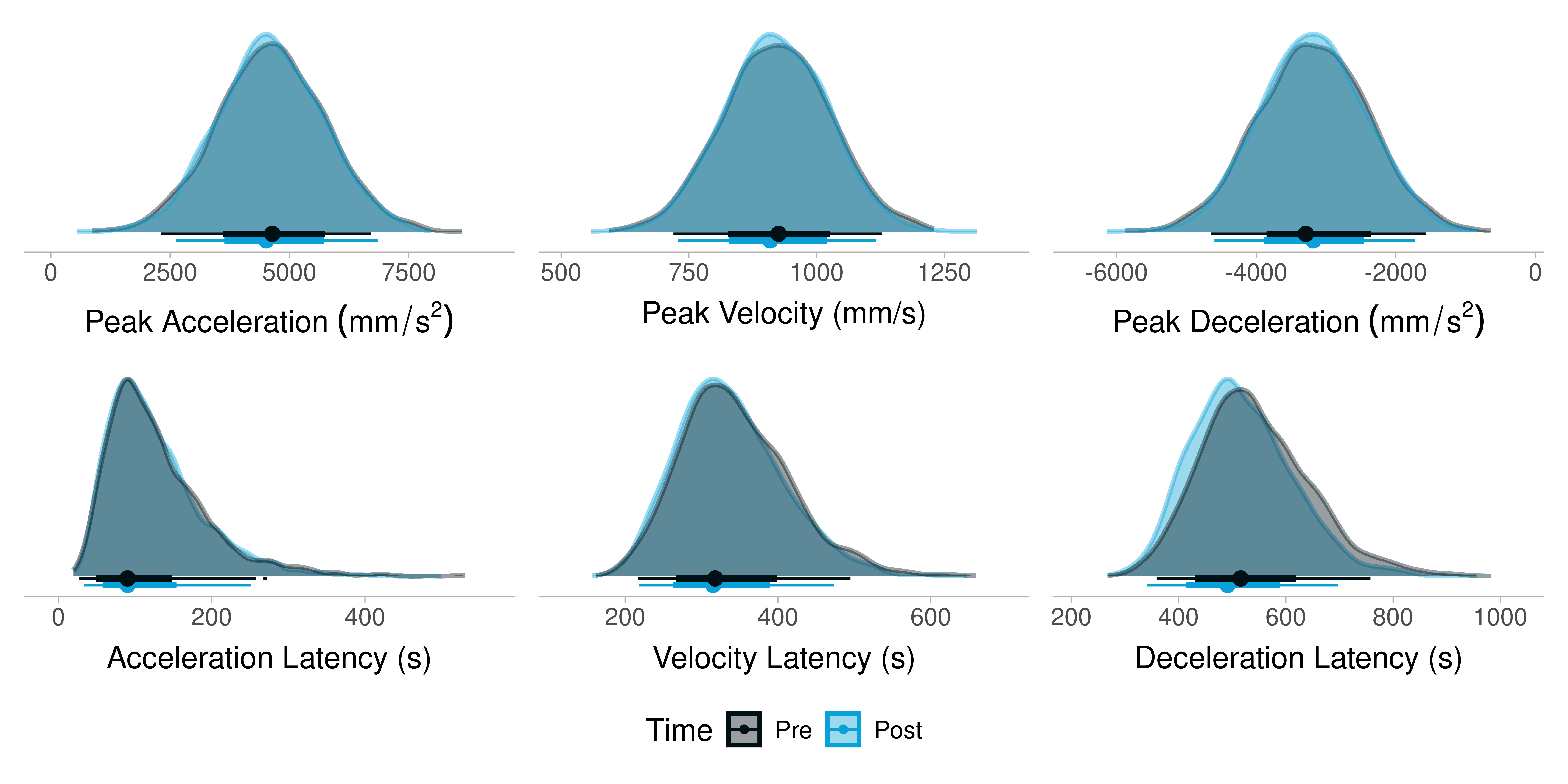
Posterior Distributions of (Unstandardized) Kinematic Parameters

Results: Reaching Task

Table 1.1 Bayes factors and posterior summary of kinematic models

95% Highest Density Interval

Outcome

BF

Mode

Lower

Upper

Peak Velocity

117\frac{1}{17}

-5.39

-45.79

39.90

Peak Acceleration

118.6\frac{1}{18.6}

-53.67

-399.04

314.61

Peak Deceleration

122.7\frac{1}{22.7}

13.24

-306.57

232.19

Velocity Latency

1503\frac{1}{503}

-8.12

-28.11

12.84

Acceleration Latency

1308\frac{1}{308}

-2.53

-12.69

6.94

Deceleration Latency

1971\frac{1}{971}

-23.84

-53.88

0.47

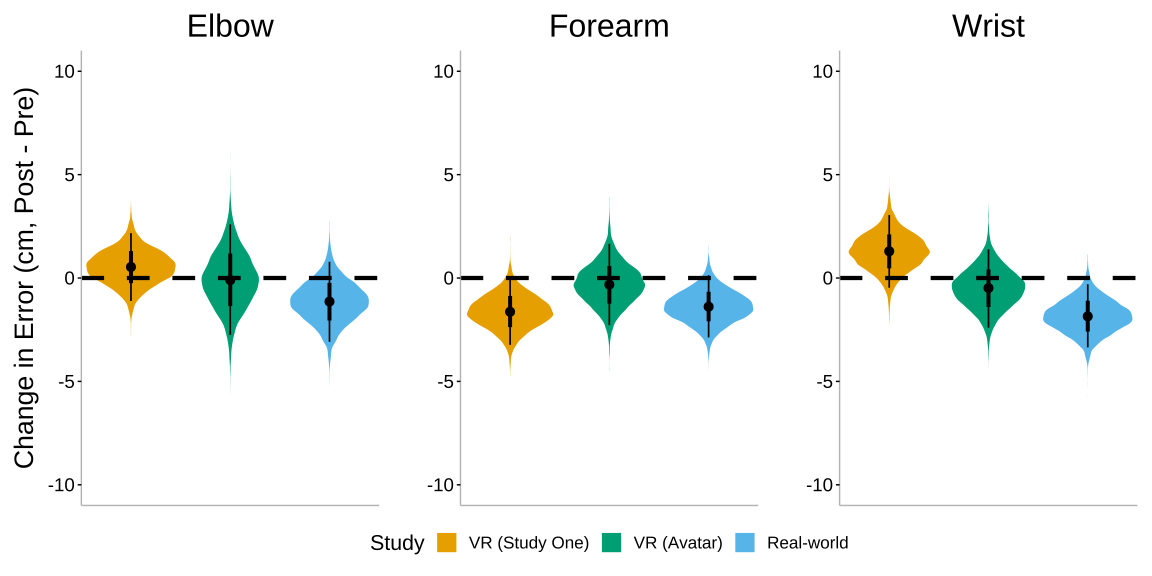
Results: Landmark Localization

Results: Landmark Localization

Bayes Factors and posterior summary of landmark estimation model parameters.

95% Highest Density Interval

Target

BF

Mode

Lower

Upper

Wrist

13.1913.19

1.33

-0.43

3.05

Forearm

144.5\frac{1}{44.5}

-1.60

-3.23

-0.02

Elbow

2.882.88

0.53

-1.19

2.16

Conclusion: Study 1

H1: Shorter kinematic peaks and longer latencies post tool-use.

H2: Distal landmark localization biases post tool-use.

Result: No evidence for an effect of tool-use on kinematics, some evidence for change in localizations.

H3: A relationship between the effect of tool-use on movement characteristics and the effect on landmark localizations.

Result: Unable to test due to lack of effect of tool-use on either outcome.

  • Display of virtual environment may be responsible:

    • No virtual body (visual-proprioceptive mismatch)1
    • Visual perception might differ from real world2

Manuscript Two: Just a Tool, After All?

Motivations: Revisited

  • Revised plan:
    1. Investigate the role of visual feedback of the body (Avatar VR)
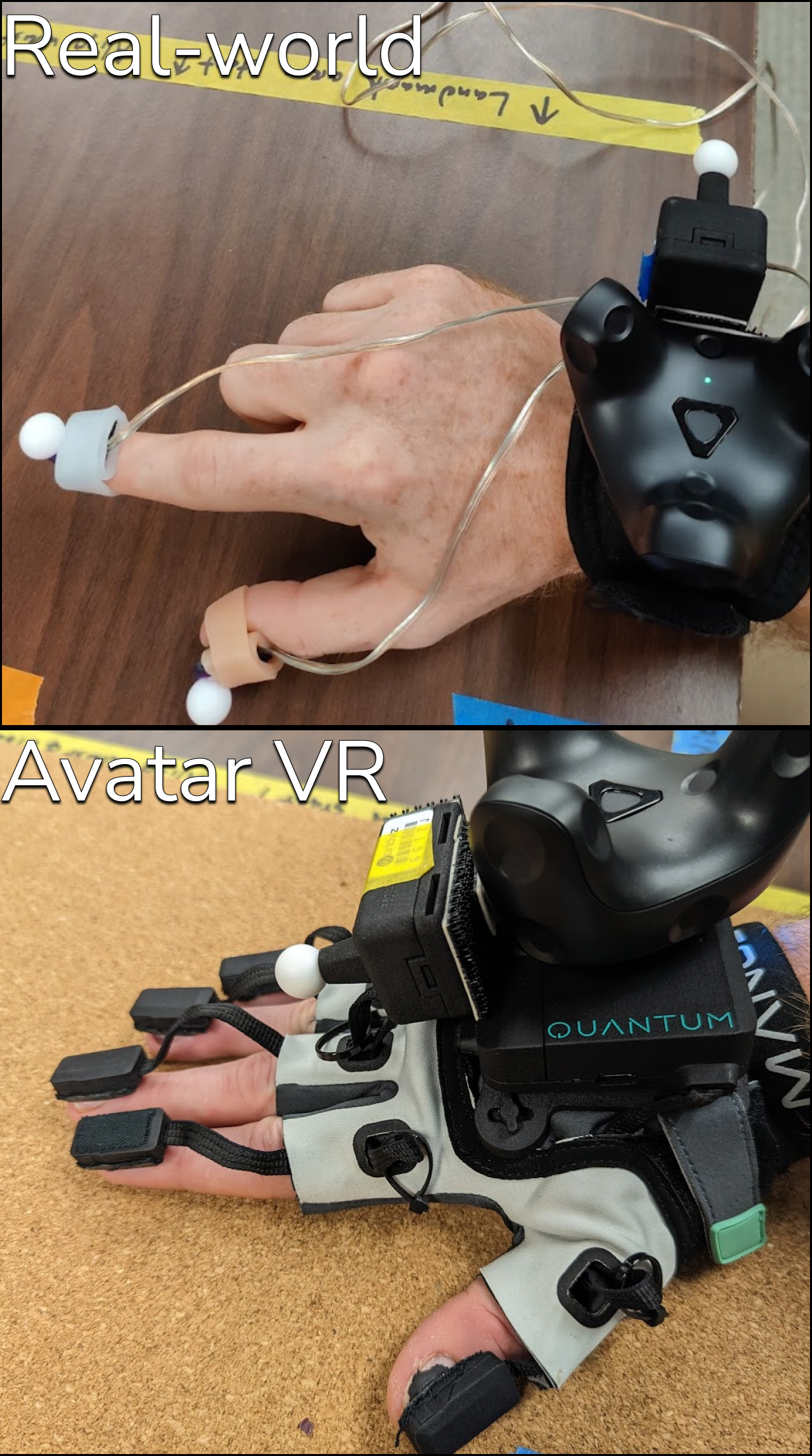
    2. Reproduce the effects in a real environment (Real-world)
    3. Collect data to address validity concerns

Method

Participants

  • Used the same sampling strategy as Study 1.
  • Avatar VR:
    • n = 24 participants
      • \(M_{age} = 25.09\) years, \(SD_{age} = 8.87\)
      • 13 female, 9 male, 2 non-binary
  • Real-world:
    • n = 24 participants
      • \(M_{age} = 34.2\) years, \(SD_{age} = 15.6\)
      • 14 female, 10 male

Method

Changes: Virtual Environment

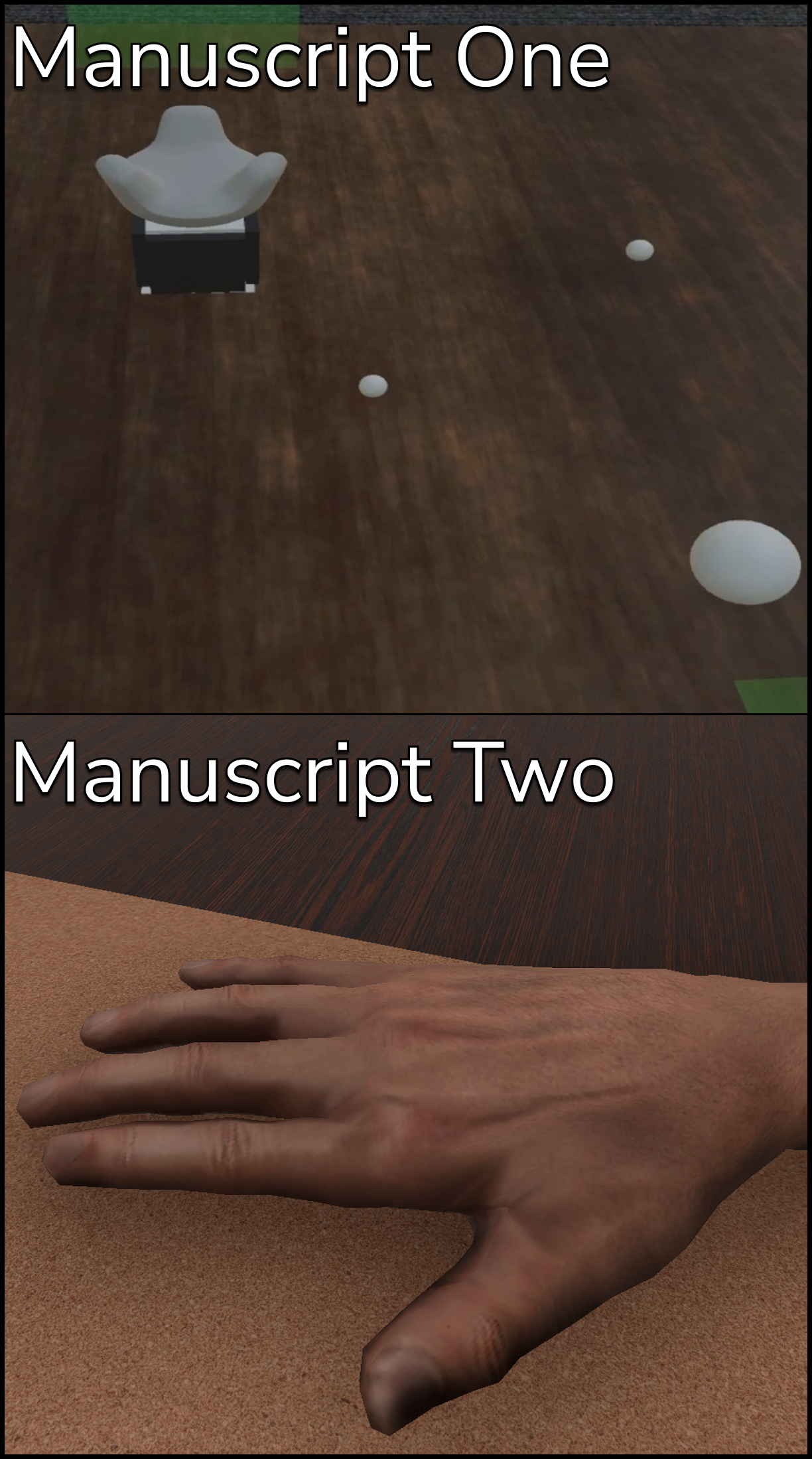
  • Remodeled Environment and Objects1
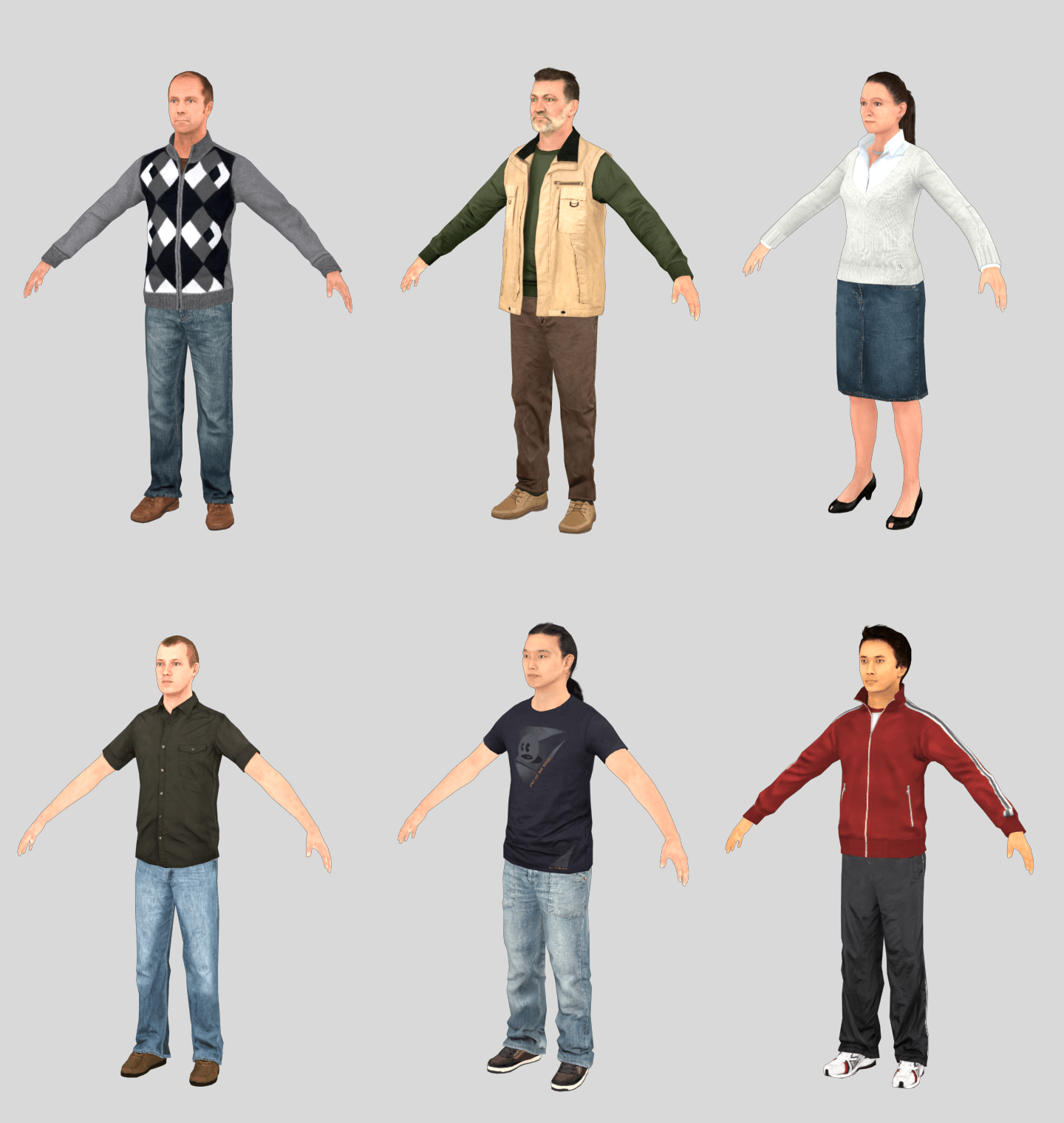
  • Microsoft Rocketbox Avatars2
    • Inverse Kinematics (via FinalIK)
  • Hand Tracking via Manus Quantum

Changes: Procedure

Avatar Calibration

Changes: Procedure

Tasks

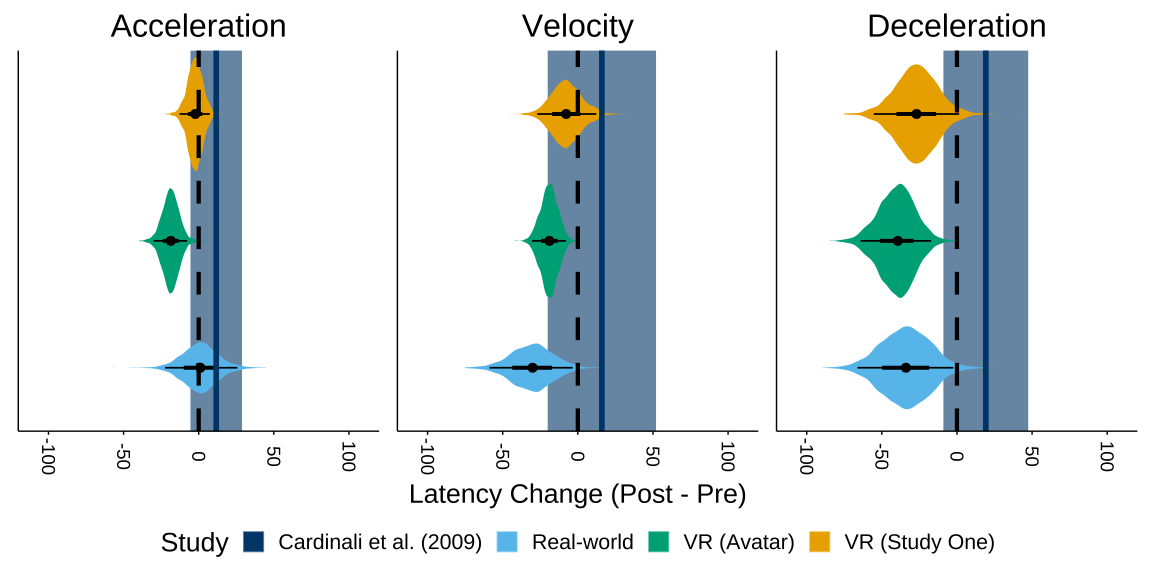
Results: Reaching Task

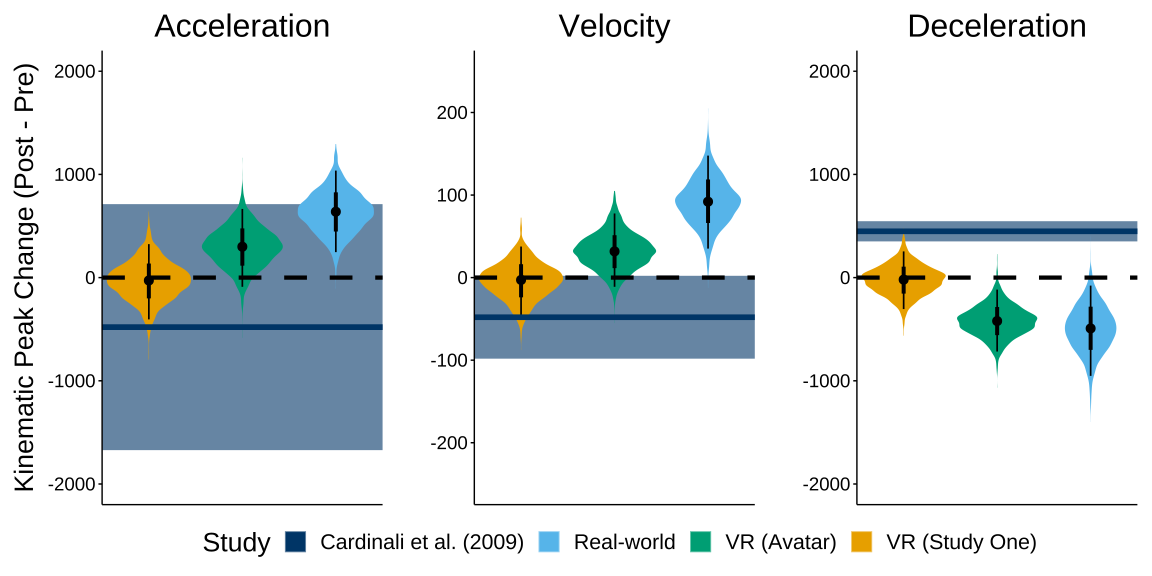
Peaks

Results: Reaching Task

Latencies

Results: Reaching Task

Bayes factors and posterior summary of kinematic models (Avatar VR)

95% Highest Density Interval

Outcome

BF

Mode

Lower

Upper

Peak Velocity

147.8\frac{1}{47.8}

32.74

-11.44

76.36

Peak Acceleration

157\frac{1}{57}

305.29

-75.91

680.85

Peak Deceleration

160\frac{1}{60}

-428.52

-712.99

-110.00

Velocity Latency

11797\frac{1}{1797}

-19.53

-28.98

-6.61

Acceleration Latency

1932\frac{1}{932}

-19.31

-30.63

-8.41

Deceleration Latency

11243\frac{1}{1243}

-38.32

-62.16

-15.08

Results: Reaching Task

Bayes factors and posterior summary of kinematic models (Real-world)

95% Highest Density Interval

Outcome

BF

Mode

Lower

Upper

Peak Velocity

150.4\frac{1}{50.4}

98.86

38.46

150.09

Peak Acceleration

157.1\frac{1}{57.1}

638.46

229.67

1,007.20

Peak Deceleration

156.4\frac{1}{56.4}

-476.20

-906.76

-30.18

Velocity Latency

11006\frac{1}{1006}

-32.38

-58.11

-2.14

Acceleration Latency

1182\frac{1}{182}

-2.09

-22.85

25.60

Deceleration Latency

11004\frac{1}{1004}

-34.31

-69.63

-2.88

Results: Landmark Localization

Results: Landmark Localization

Bayes Factors and posterior summary of landmark estimation model parameters (Avatar VR)

95% Highest Density Interval

Target

BF

Mode

Lower

Upper

Wrist

12.3\frac{1}{2.3}

-0.56

-2.28

1.59

Forearm

0.60.6

-0.21

-2.39

1.61

Elbow

0.890.89

-0.20

-2.84

2.50

Results: Landmark Localization

Bayes Factors and posterior summary of landmark estimation model parameters (Real-world)

95% Highest Density Interval

Target

BF

Mode

Lower

Upper

Wrist

153.1\frac{1}{53.1}

-1.65

-3.15

-0.14

Forearm

113.3\frac{1}{13.3}

-1.11

-2.62

0.34

Elbow

14.6\frac{1}{4.6}

-0.93

-2.91

0.99

General Discussion

  • No evidence of tool-use effects1 in VR or real-world scenarios
  • Revised VR and real-world scenarios saw movement in the opposite direction
    • Not without precedent, seen in younger (age <18) participants2
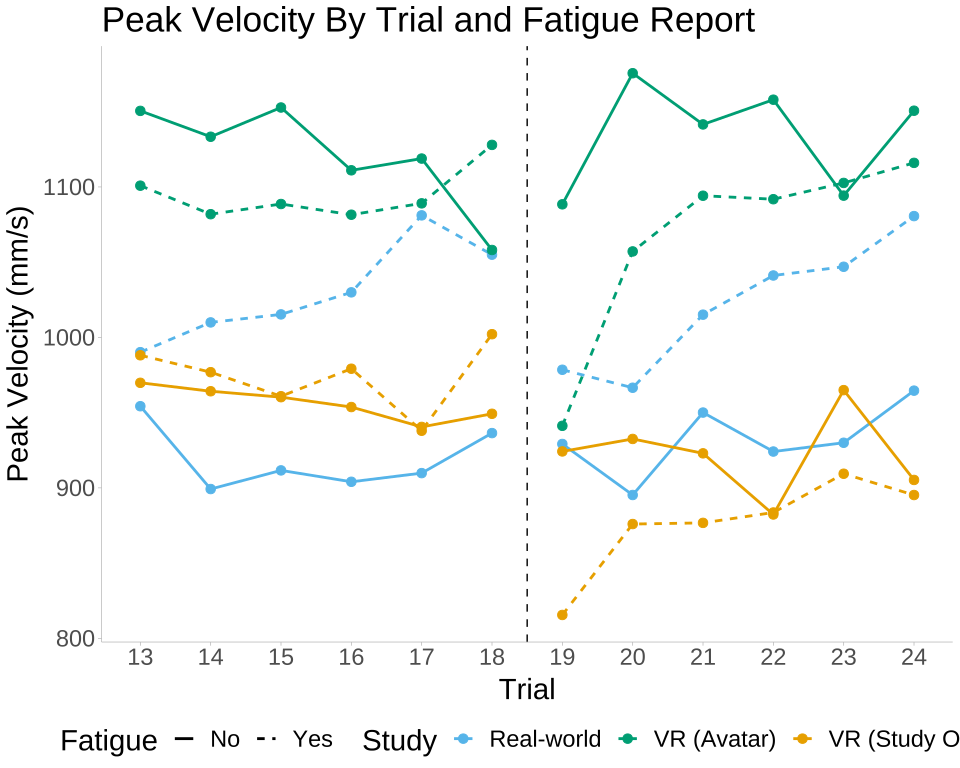
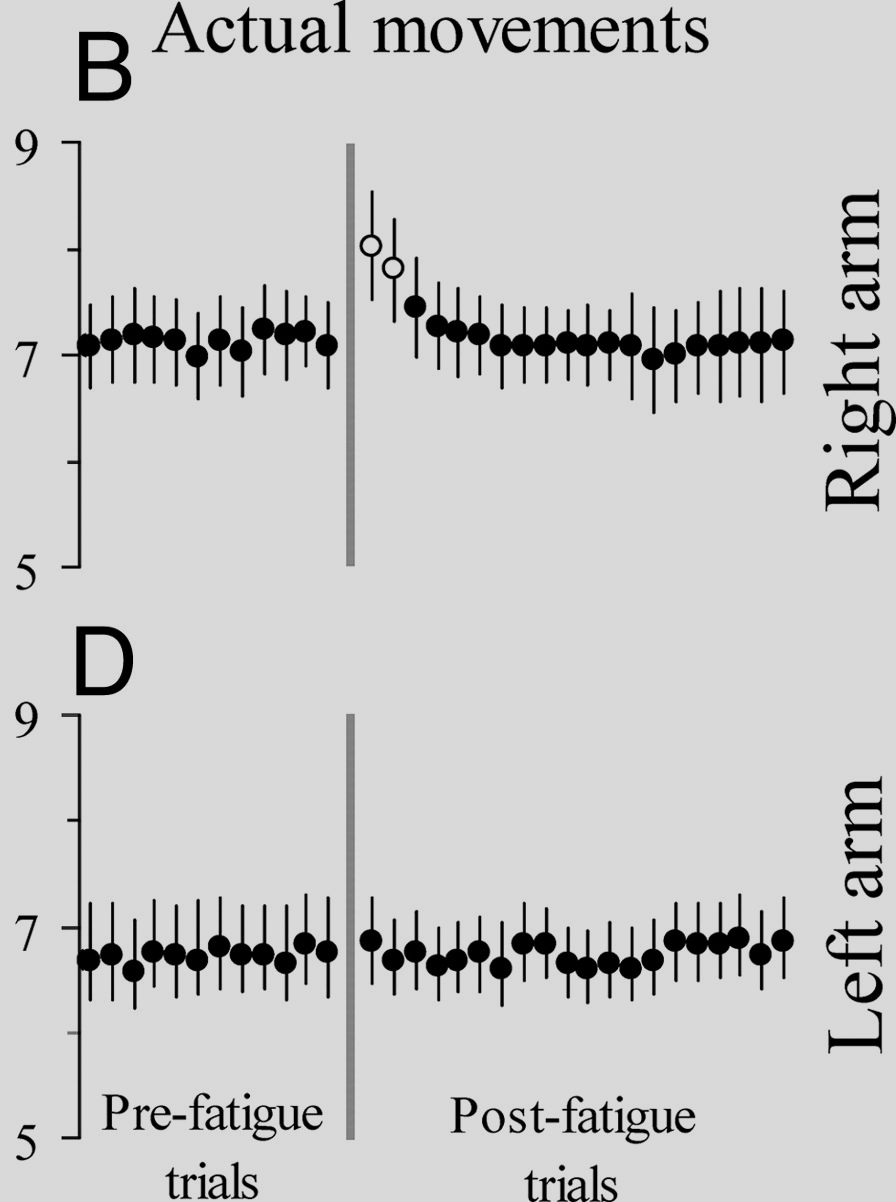
  • Differences in results may be related to fatigue or demand characteristics

Occam’s Razor: A role of fatigue?

Demougeot et al. (2011)

Occam’s Razor: A role of fatigue?

  • “Ruled out” by a 300g (.66lbs, the weight of the tool) wrist-weight1
  • Insufficient, because:
    • Tool weight is distal of the wrist
    • The handle requires >7lbs of force to compress
    • Squeezed 96 times during the task

Demand Characteristics

  • “The totality of cues which convey an experimental hypothesis to the subject”1
  • Recently implicated in the Rubber Hand Illusion2 and embodiment3
    • Participants who watched videos of the RHI and embodiment studies matched responses of actual experience
  • In the studies reported here, we tried to control for this element
    • All instructions were standardized, non-leading and task-focused
    • ~75% of participants guessed a performance-related hypothesis
    • After receiving embodiment inventories, 63% (in Avatar VR) changed hypothesis to embodiment

Conclusion

  • We observed no evidence of tool-use effects in VR or real-world scenarios
    • i.e., no evidence of tool embodiment
  • Movement characteristics and landmark localization may not be capturing “embodiment”
  • These results should encourage reflection on the role of external variables in tool-use effects
  • Future work should experimentally manipulate fatigue and demand characteristics

Extra

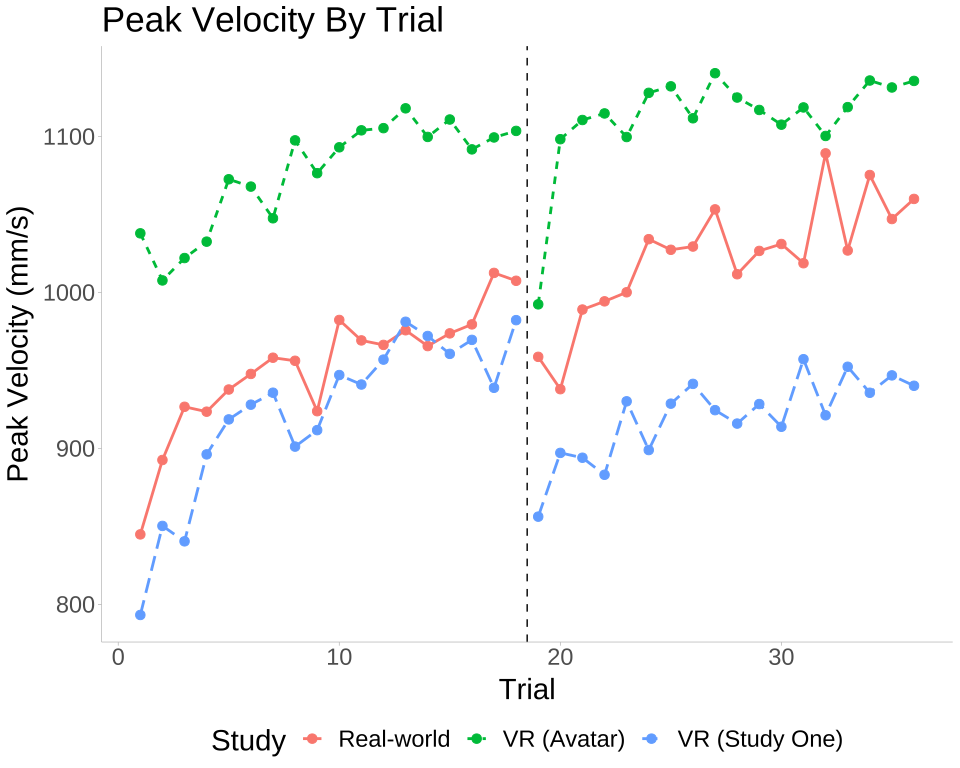
Velocity across trials by fatigue

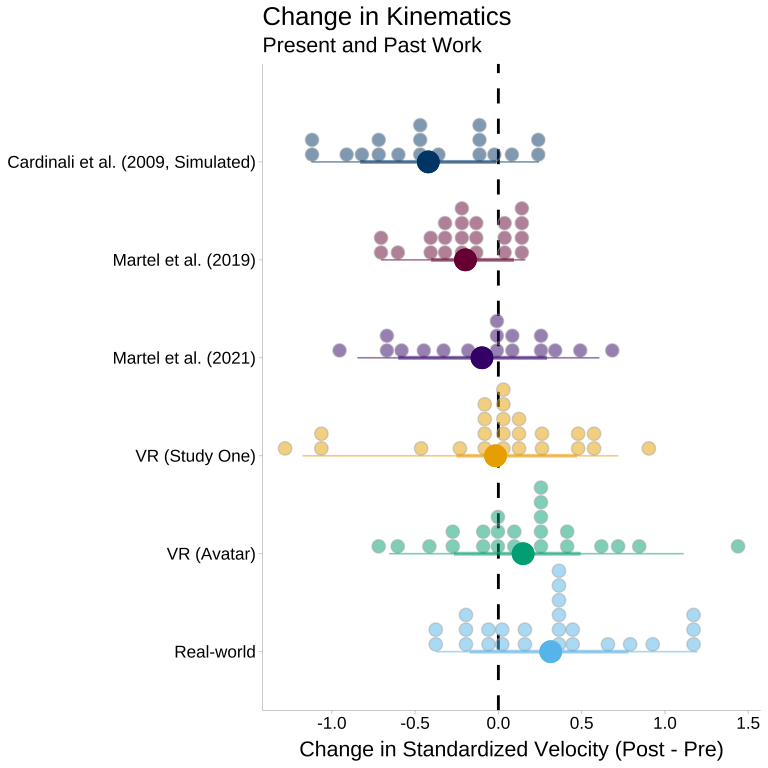
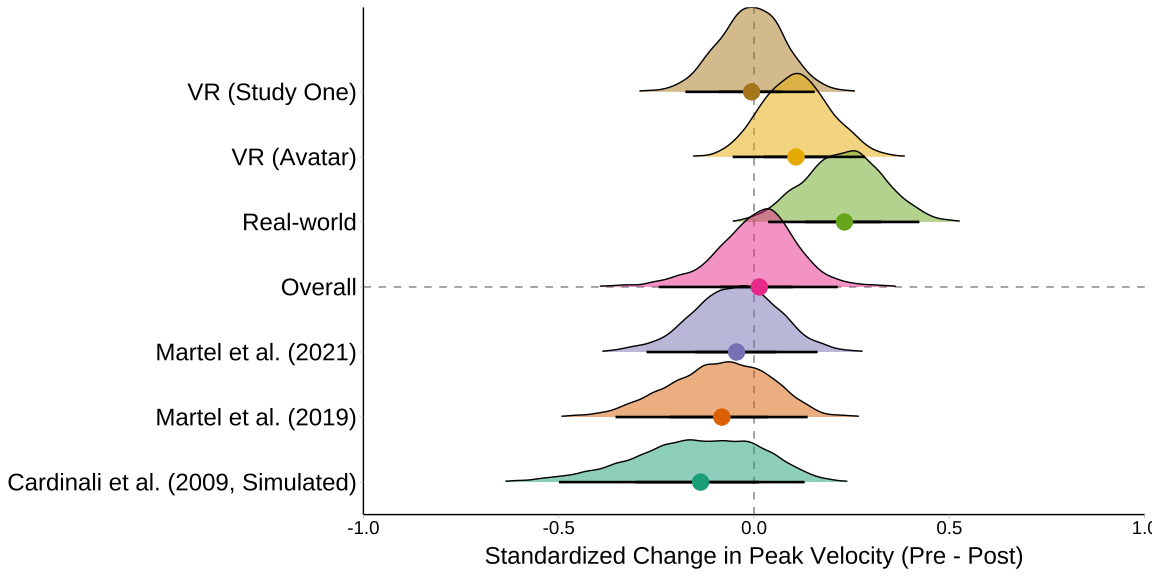
Exploratory Meta-Analysis

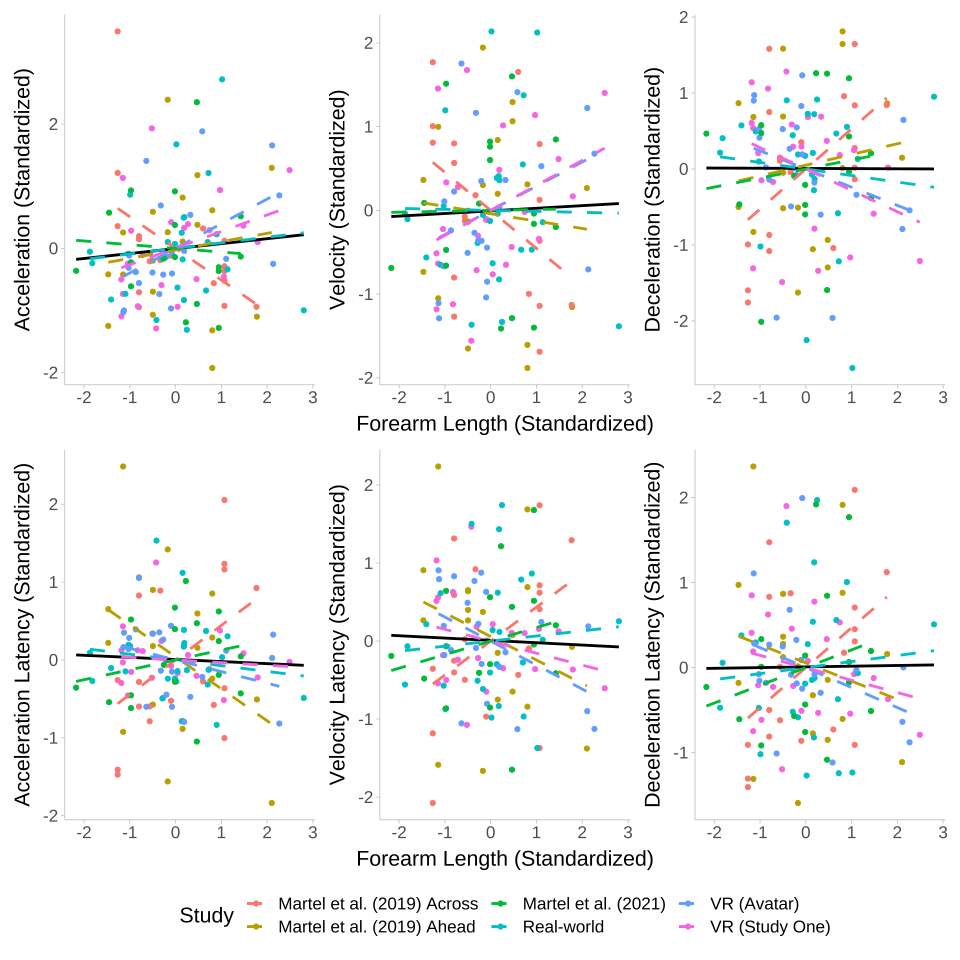
No Effect of Forearm Length on Movement

Tool Embodiment

  • Embodied Cognition: Cognition is not just a function of the brain, but also of the body1

    • Body not a passive conduit, but an active participant in cognition
    • Cognition adapts to present context
    • “Embodiment” is becoming part of cognition
    • Some argue that the embodiment of external objects is possible2

Power Analysis & Sample

  • Gathered and combined kinematic data from prior works1
  • Followed Kruschke and Liddell (2018) method (two-fold simulation)
  • Preregistered a sequential Bayes Factor design with minimum n = 24.

Changes: Procedure

Real-world

  • Real-world:
    • HMD only used for landmarks task
    • Instructions revised, delivered via 24” monitor

Analysis Plan

Kinematic Models

Peaks used standardized values of kinematic variables

velocity_peak_priors <- brm(
  vel_m_filt_std ~ 1 + time + (1 + time | ppid), 
  data = ppt_peaks, 
  family = gaussian,
  prior = c(
    set_prior(prior = "normal(-.2, 2)", class = "b", coef = "timePost"),
    set_prior(prior = "normal(0, 2)", class = "Intercept"),
    set_prior(prior = "exponential(1)", class = "sd"), 
    set_prior(prior = "exponential(1)", class = "sigma"),
    set_prior(prior = "lkj(1)", class = "cor", group = "ppid")
  ),
  sample_prior = "only",
  seed = 1337,
  silent = TRUE, refresh = 0,
  save_pars = save_pars(all = TRUE),
  warmup = b, iter = i, chains = ch, cores = co,
  control = control_list
  )

Analysis Plan

Kinematic Models

Latencies were unstandardized, and priors were based on Rstanarm defaults, centered on the mean, and with a sd of 2.5 times the sd of the data.

velocity_latency_priors <- brm(
  vel_lat_filt ~ 1 + time + (1 + time | ppid), 
  data = ppt_acceleration_and_latencies, 
  family = lognormal,
  prior = c(
     prior_string(
       prior = paste0("normal(",
         round(log(
          ppt_acceleration_and_latencies[,sd(vel_lat_filt)] / 5
         ), 2), ",",
         round(log(
          ppt_acceleration_and_latencies[,sd(vel_lat_filt)] * 2.5
         ), 2), ")"
       ),
       class = "b"),
    # Use rstanarm approach to set Intercept prior
    # Use normal with mean of response, and sd of response * 2.5
    prior_string(
      prior = paste0("normal(",
         round(log(
          ppt_acceleration_and_latencies[,mean(vel_lat_filt)]
         ), 2), ",",
         round(log(
          ppt_acceleration_and_latencies[,sd(vel_lat_filt)] * 2.5
         ), 2), ")"
       ),
      class = "Intercept"),
    prior(prior = "exponential(1)", class = "sd"),
    prior(prior = "exponential(1)", class = "sigma"),
    prior(prior = "lkj(1)", class = "cor", group = "ppid")
            ),
  sample_prior = "only",
  seed = 1337,
  silent = 2, refresh = 0,
  save_pars = save_pars(all = TRUE),
  warmup = b, iter = i, chains = ch, cores = co,
  control = control_list
  )

Analysis Plan

Landmark Model

landmark_time_target_priors <- brm(
    bf(error_std ~ 0 + a + b * time + d,
        a ~ 0 + target,
        b ~ 0 + target,
        d ~ 0 + (0 + target + time + target:time | ppid),
        nl = TRUE
    ),
    prior = c(
        prior("normal(0, 2)", nlpar = "a"),
        prior("normal(.2, 2)", nlpar = "b"),
        # prior("normal(0, .5)", nlpar = "c"),
        prior("exponential(1)", class = "sd", nlpar = "d"),
        prior("exponential(1)", class = "sigma"),
        set_prior(prior = "lkj(1)", class = "cor", group = "ppid")
    ),
    data = landmark_summary,
    sample_prior = "only",
    seed = 1337,
    silent = TRUE, refresh = 0,
    save_pars = save_pars(all = TRUE),
    warmup = b,
    iter = i,
    chains = ch,
    cores = co,
    control = list(adapt_delta = .975, max_treedepth = 15)
)

Changes: Procedure

Avatar Calibration

References

Bahmad, Salam, Luke E. Miller, Minh Tu Pham, et al. 2020. “Online Proprioception Feeds Plasticity of Arm Representation Following Tool-Use in Healthy Aging.” Scientific Reports 10 (1): 17275. https://doi.org/10.1038/s41598-020-74455-5.
Bell, Joshua D. 2021. “Virtual Tool-Use: Do Tool-Use Effects Extend to Virtual Reality?” Repository. In Open Science Framework. Https://osf.io/n3r8a/?view_only=70a680c21b9f42a3b16fbb5e04a8c5fc; OSF.
Bell, Joshua D., and Kristen L. Macuga. 2022a. Knowing Your Boundaries: No Effect of Tool-use on Body Representation Following a Gather-and-Sort Task. PsyArXiv. https://doi.org/10.31234/osf.io/8p6hc.
Bell, Joshua D., and Kristen L. Macuga. 2022b. “Knowing Your Boundaries: No Effect of Tool-Use on Body Representation Following a Gather-and-Sort Task.” Repository. In Open Science Framework. Https://osf.io/5x7h6/; OSF.
Bongers, Raoul M. 2010. “Do Changes in Movements After Tool Use Depend on Body Schema or Motor Learning?” In Haptics: Generating and Perceiving Tangible Sensations, edited by Astrid M. L. Kappers, Jan B. F. van Erp, Wouter M. Bergmann Tiest, and Frans C. T. van der Helm. Lecture Notes in Computer Science. Springer. https://doi.org/10.1007/978-3-642-14075-4_39.
Brookes, Jack, Matthew Warburton, Mshari Alghadier, Mark Mon-Williams, and Faisal Mushtaq. 2020. “Studying Human Behavior with Virtual Reality: The Unity Experiment Framework.” Behavior Research Methods 52 (2): 455–63. https://doi.org/10.3758/s13428-019-01242-0.
Bürkner, Paul-Christian. 2021. Brms: Bayesian Regression Models Using Stan. https://CRAN.R-project.org/package=brms.
Cardinali, L., F. Frassinetti, C. Brozzoli, C. Urquizar, A. C. Roy, and A. Farne. 2009. “Tool-Use Induces Morphological Updating of the Body Schema.” Curr Biol 19 (12): R478–9. https://doi.org/10.1016/j.cub.2009.05.009.
de Vignemont, Frédérique. 2010. “Body Schema and Body Image and Cons.” Neuropsychologia 48 (3): 669–80.
de Vignemont, Frédérique. 2011. “Embodiment, Ownership and Disownership.” Consciousness and Cognition, Brain and Self: Bridging the Gap, vol. 20 (1): 82–93. https://doi.org/10.1016/j.concog.2010.09.004.
Firestone, Chaz, and Brian J. Scholl. 2016. “Cognition Does Not Affect Perception: Evaluating the Evidence for ‘Top-down’ Effects.” Behavioral and Brain Sciences 39: e229. https://doi.org/10.1017/S0140525X15000965.
Forster, Pierre-Pascal, Harun Karimpur, and Katja Fiehler. 2022. “Demand Characteristics Challenge Effects in Embodiment and Presence.” Scientific Reports 12 (1): 14084. https://doi.org/10.1038/s41598-022-18160-5.
Gonzalez-Franco, Mar, Eyal Ofek, Ye Pan, et al. 2020. “The Rocketbox Library and the Utility of Freely Available Rigged Avatars.” Frontiers in Virtual Reality 1.
Harris, David J., Gavin Buckingham, Mark R. Wilson, and Samuel J. Vine. 2019. “Virtually the Same? How Impaired Sensory Information in Virtual Reality May Disrupt Vision for Action.” Experimental Brain Research 237 (11): 2761–66. https://doi.org/10.1007/s00221-019-05642-8.
Henry, F. M., and J. D. Whitley. 1960. “Relationships Between Individual Differences in Strength, Speed, and Mass in an Arm Movement.” Research Quarterly. American Association for Health, Physical Education and Recreation 31 (1): 24–33. https://doi.org/10.1080/10671188.1960.10613073.
Koepke, C. A., and L. S. Whitson. 1941. “Summary of a Series of Experiments to Determine the Power and Velocity of Motions Occurring in Manual Work.” Journal of Applied Psychology (US) 25 (2): 251–64. https://doi.org/10.1037/h0059316.
Kruschke, John K., and Torrin M. Liddell. 2018. “The Bayesian New Statistics: Hypothesis Testing, Estimation, Meta-Analysis, and Power Analysis from a Bayesian Perspective.” Psychonomic Bulletin & Review 25 (1): 178–206. https://doi.org/10.3758/s13423-016-1221-4.
Lanier, Madison, T. Franklin Waddell, Malte Elson, Daniel J. Tamul, James D. Ivory, and Andrew Przybylski. 2019. “Virtual Reality Check: Statistical Power, Reported Results, and the Validity of Research on the Psychology of Virtual Reality and Immersive Environments.” Computers in Human Behavior 100 (November): 70–78. https://doi.org/10.1016/j.chb.2019.06.015.
Lush, Peter, Simine Vazire, and Alex Holcombe. 2020. “Demand Characteristics Confound the Rubber Hand Illusion.” Collabra: Psychology 6 (1). https://doi.org/10.1525/collabra.325.
Makowski, Dominique, Daniel Lüdecke, Mattan S. Ben-Shachar, Indrajeet Patil, Michael D. Wilson, and Brenton M. Wiernik. 2021. bayestestR: Understand and Describe Bayesian Models and Posterior Distributions. https://easystats.github.io/bayestestR/.
Mangalam, Madhur, Dorothy M. Fragaszy, Jeffrey B. Wagman, et al. 2022. “On the Psychological Origins of Tool Use.” Neuroscience & Biobehavioral Reviews 134 (March): 104521. https://doi.org/10.1016/j.neubiorev.2022.104521.
Martel, M., L. Cardinali, G. Bertonati, et al. 2019. “Somatosensory-Guided Tool Use Modifies Arm Representation for Action.” Scientific Reports 9 (1): 5517. https://doi.org/10.1038/s41598-019-41928-1.
Martel, M., Livio Finos, Eric Koun, Alessandro Farnè, and Alice Catherine Roy. 2021. “The Long Developmental Trajectory of Body Representation Plasticity Following Tool Use.” Scientific Reports 11 (1): 559. https://doi.org/10.1038/s41598-020-79476-8.
Miller, Luke E., Matthew R. Longo, and Ayse P. Saygin. 2017. “Visual Illusion of Tool Use Recalibrates Tactile Perception.” Cognition 162: 32–40.
Miller, Luke E., Luca Montroni, Eric Koun, Romeo Salemme, Vincent Hayward, and Alessandro Farnè. 2018. “Sensing with Tools Extends Somatosensory Processing Beyond the Body.” Nature 561 (7722): 239–42. https://doi.org/10.1038/s41586-018-0460-0.
Orne, Martin T. 1962. “On the Social Psychology of the Psychological Experiment: With Particular Reference to Demand Characteristics and Their Implications.” American Psychologist (US) 17: 776–83. https://doi.org/10.1037/h0043424.
Rasch, Philip J. 1954. “Relationship of Arm Strength, Weight, and Length to Speed of Arm Movement.” Research Quarterly. American Association for Health, Physical Education and Recreation 25 (3): 328–32. https://doi.org/10.1080/10671188.1954.10624975.
Romano, Daniele, and Angelo Maravita. 2021. “Plasticity and Tool Use in the Body Schema.” In Body Schema and Body Image: New Directions, edited by Yochai Ataria, Shogo Tanaka, and Shaun Gallagher. Oxford University Press. https://doi.org/10.1093/oso/9780198851721.003.0008.
Scarfe, Peter, and Andrew Glennerster. 2019. “The Science Behind Virtual Reality Displays.” Annual Review of Vision Science 5 (1): 529–47. https://doi.org/10.1146/annurev-vision-091718-014942.
Schettler, Aubrie, Vicente Raja, and Michael L. Anderson. 2019. “The Embodiment of Objects: Review, Analysis, and Future Directions.” Frontiers in Neuroscience 13.
Schönbrodt, Felix D., and Eric-Jan Wagenmakers. 2018. “Bayes Factor Design Analysis: Planning for Compelling Evidence.” Psychonomic Bulletin & Review 25 (1): 128–42. https://doi.org/10.3758/s13423-017-1230-y.
Shapiro, Lawrence, and Shannon Spaulding. 2021. Embodied Cognition. June.
Vasser, Madis, and Jaan Aru. 2020. “Guidelines for Immersive Virtual Reality in Psychological Research.” Current Opinion in Psychology, Cyberpsychology, vol. 36 (December): 71–76. https://doi.org/10.1016/j.copsyc.2020.04.010.
Vittersø, Axel D., Gavin Buckingham, Monika Halicka, Michael J. Proulx, and Janet H. Bultitude. 2020. “Altered Updating of Bodily and Spatial Representations Following Tool-Use in Complex Regional Pain Syndrome.” PAIN Articles in Press. https://doi.org/10.1097/j.pain.0000000000001845.
Vittersø, Axel D., Monika Halicka, Gavin Buckingham, Michael J. Proulx, and Janet H. Bultitude. 2019. “Experimentally Induced Pain Does Not Influence Updating of Peripersonal Space and Body Representations Following Tool-Use.” PLoS ONE 14 (5). https://doi.org/10.1371/journal.pone.0210045.